"If against these Indians, the end proposed should be their extermination, or their removal beyond the lakes or Illinois river. The same world will scarcely do for them and us."
Following this TJ first wrote and then deleted:
“I think the most important object which can be proposed with such a force is the extermination of those hostile tribes of Indians who live between the Ohio and Illinois who have harrassed us with eternal hostilities, and whom experience has shewn to be incapable of reconciliation. The Shawanese, Mingos, Munsies and Wiandots can never be relied on as friends, and therefore the object of the war should be their total extinction, or their removal beyond the lakes or the Illinois river and peace" (Jefferson, January 1, 17[80]).
“From Thomas Jefferson to George Rogers Clark, 1 January 17[80],” Founders Online, National Archives, last modified December 6, 2016, http://founders.archives.gov/documents/Jefferson/01-03-02-0289. [Original source: The Papers of Thomas Jefferson, vol. 3, 18 June 1779 – 30 September 1780, ed. Julian P. Boyd. Princeton: Princeton University Press, 1951, pp. 258–259.]
Wednesday, December 28, 2016

Thursday, December 22, 2016
To remove all reasonable Cause of Discontent
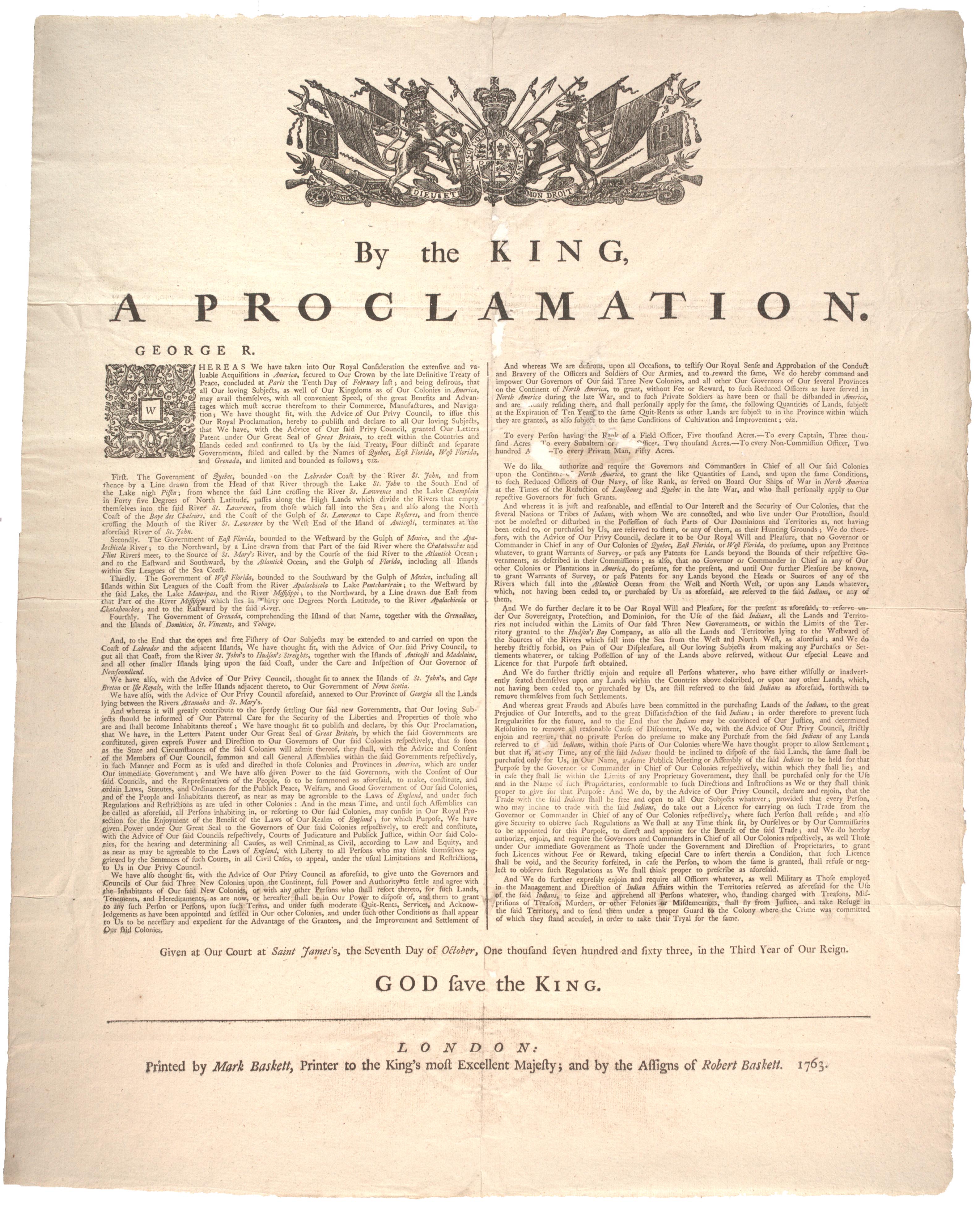
"And We do further declare it to be Our Royal Will and Pleasure, for the present as aforesaid, to reserve under Our Sovereignty, Protection, and Dominion, for the Use of the said Indians, all the Lands and Territories not included within the Limits of Our said Three New Governments, or within the Limits of the Territory granted to the Hudson's Bay Company, as also all the Lands and Territories lying to the Westward of the Sources of the Rivers which fall into the Sea from the West and North West, as aforesaid; and We do hereby strictly forbid, on Pain of Our Displeasure, all Our loving Subjects from making any Purchases or Settlements whatever, or taking Possession of any of the Lands above reserved, without Our especial Leave and Licence for that Purpose first obtained.
And We do further strictly enjoin and require all Persons whatever, who have either wilfully or inadvertently seated themselves upon any Lands within the Countries above described, or upon any other Lands, which, not having been ceded to, or purchased by Us, are still reserved to the said Indians as aforesaid, forthwith to remove themselves from such Settlements.
And whereas great Frauds and Abuses have been committed in the purchasing Lands of the Indians, to the great Prejudice of Our Interests, and to the great Dissatisfaction of the said Indians; in order therefore to prevent such Irregularities for the future, and to the End that the Indians may be convinced of Our Justice, and determined Resolution to remove all reasonable Cause of Discontent..."
King George III. Proclamation of 1763, October 1763. MS. The Glider Lehrman Collection, The Glider Lehrman Institute of American History, New York. 22 Dec. 2016. Web. https://www.gilderlehrman.org/collections/244f978b-2cbf-4295-9b03-924022753327
Monday, December 19, 2016
No people could be in a more allarming situation
"to enumerate all the little actions that happened it is Impossible they ware continual and frequently sevear whin compared to our small forces the Forts ware often attacted (policy seem to have Required that the whole should be imbodied in one place but depending on Hunting for the greatest part of our provisions forbid it) no people could be in a more allarming situation detached at least two Hundred miles from the nearest settlement of the States surrounded by numerous Nations of Indians each on far superior in number to ourselves and under the Influance of the British government and pointedly directed to distroy us as appeared by many Instruments of writing left on the brest of people Kiled by them I was frequently affraid that the people would think of Making their peace with DeTroit and suffer themselves and their families to be carried of (Clark, 216)...
Clark, George R. Clark's Memoir, from English's Conquest of the Country. Ann Arbor, Mich.: University Microfilms, 1966. Print.
Clark, George R. Clark's Memoir, from English's Conquest of the Country. Ann Arbor, Mich.: University Microfilms, 1966. Print.
Subscribe to:
Comments (Atom)