"If against these Indians, the end proposed should be their extermination, or their removal beyond the lakes or Illinois river. The same world will scarcely do for them and us."
Following this TJ first wrote and then deleted:
“I think the most important object which can be proposed with such a force is the extermination of those hostile tribes of Indians who live between the Ohio and Illinois who have harrassed us with eternal hostilities, and whom experience has shewn to be incapable of reconciliation. The Shawanese, Mingos, Munsies and Wiandots can never be relied on as friends, and therefore the object of the war should be their total extinction, or their removal beyond the lakes or the Illinois river and peace" (Jefferson, January 1, 17[80]).
“From Thomas Jefferson to George Rogers Clark, 1 January 17[80],” Founders Online, National Archives, last modified December 6, 2016, http://founders.archives.gov/documents/Jefferson/01-03-02-0289. [Original source: The Papers of Thomas Jefferson, vol. 3, 18 June 1779 – 30 September 1780, ed. Julian P. Boyd. Princeton: Princeton University Press, 1951, pp. 258–259.]
Wednesday, December 28, 2016

Thursday, December 22, 2016
To remove all reasonable Cause of Discontent
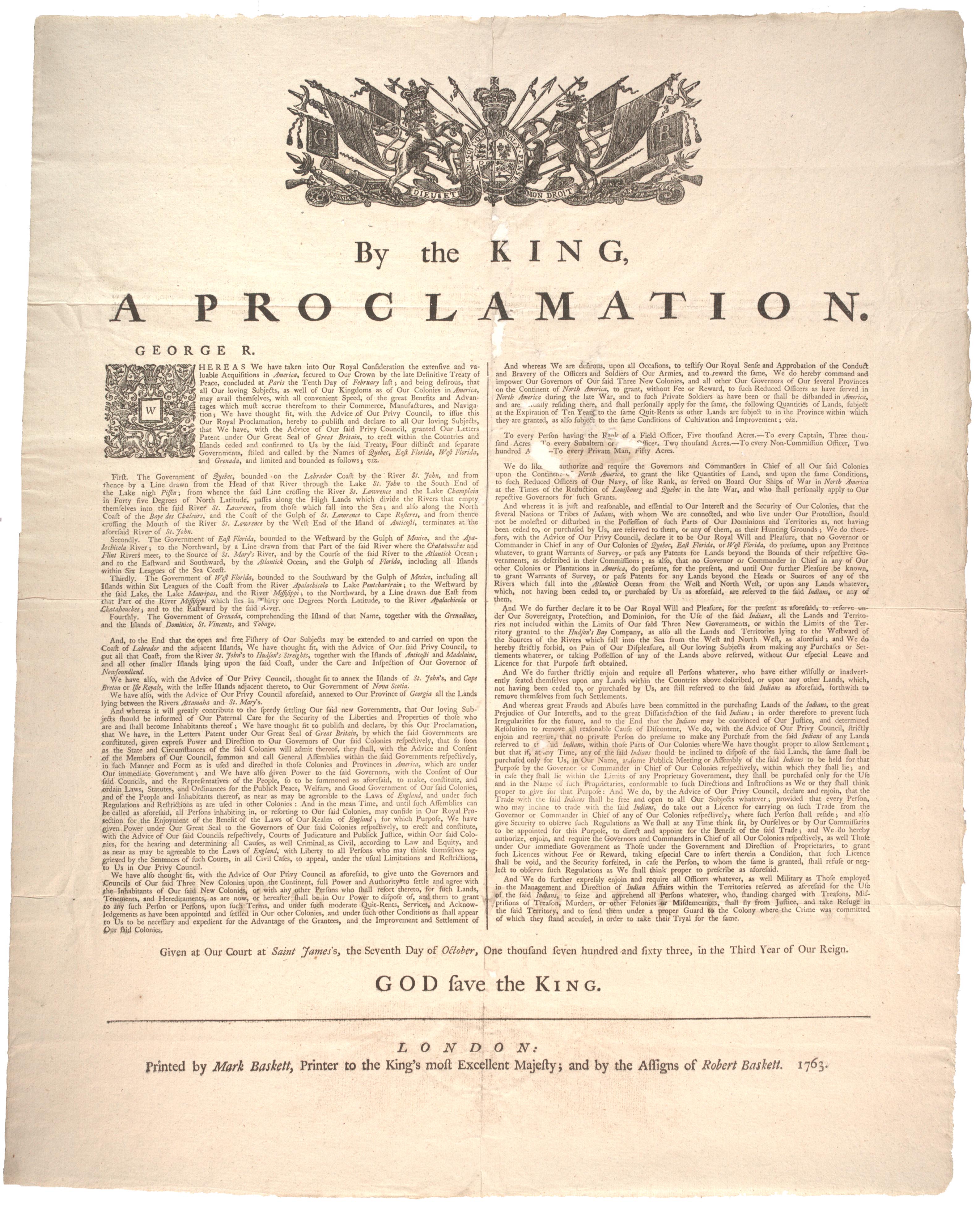
"And We do further declare it to be Our Royal Will and Pleasure, for the present as aforesaid, to reserve under Our Sovereignty, Protection, and Dominion, for the Use of the said Indians, all the Lands and Territories not included within the Limits of Our said Three New Governments, or within the Limits of the Territory granted to the Hudson's Bay Company, as also all the Lands and Territories lying to the Westward of the Sources of the Rivers which fall into the Sea from the West and North West, as aforesaid; and We do hereby strictly forbid, on Pain of Our Displeasure, all Our loving Subjects from making any Purchases or Settlements whatever, or taking Possession of any of the Lands above reserved, without Our especial Leave and Licence for that Purpose first obtained.
And We do further strictly enjoin and require all Persons whatever, who have either wilfully or inadvertently seated themselves upon any Lands within the Countries above described, or upon any other Lands, which, not having been ceded to, or purchased by Us, are still reserved to the said Indians as aforesaid, forthwith to remove themselves from such Settlements.
And whereas great Frauds and Abuses have been committed in the purchasing Lands of the Indians, to the great Prejudice of Our Interests, and to the great Dissatisfaction of the said Indians; in order therefore to prevent such Irregularities for the future, and to the End that the Indians may be convinced of Our Justice, and determined Resolution to remove all reasonable Cause of Discontent..."
King George III. Proclamation of 1763, October 1763. MS. The Glider Lehrman Collection, The Glider Lehrman Institute of American History, New York. 22 Dec. 2016. Web. https://www.gilderlehrman.org/collections/244f978b-2cbf-4295-9b03-924022753327
Monday, December 19, 2016
No people could be in a more allarming situation
"to enumerate all the little actions that happened it is Impossible they ware continual and frequently sevear whin compared to our small forces the Forts ware often attacted (policy seem to have Required that the whole should be imbodied in one place but depending on Hunting for the greatest part of our provisions forbid it) no people could be in a more allarming situation detached at least two Hundred miles from the nearest settlement of the States surrounded by numerous Nations of Indians each on far superior in number to ourselves and under the Influance of the British government and pointedly directed to distroy us as appeared by many Instruments of writing left on the brest of people Kiled by them I was frequently affraid that the people would think of Making their peace with DeTroit and suffer themselves and their families to be carried of (Clark, 216)...
Clark, George R. Clark's Memoir, from English's Conquest of the Country. Ann Arbor, Mich.: University Microfilms, 1966. Print.
Clark, George R. Clark's Memoir, from English's Conquest of the Country. Ann Arbor, Mich.: University Microfilms, 1966. Print.
Saturday, August 27, 2016
The bullet passed through 9 folds of the blanket
"My brother was shot through the center of the body, and through the ligaments at the hips, so that he fell. When he rose again, he said he saw an Indian loading his gun in full view so that he could have shot him, with the greatest ease, but that he was too weak and turned to run. By this time the Indian had loaded and fired again. The bullet passed through 9 folds of the blanket he had rolled up and strapped to his shoulders, and then stopped, and made flat as a 9d. The force of the blow knocked him down again, but did not get through the blanket to the skin" (Draper MSS, James Wade Interview, 12cc11-41).
Draper, Lyman C. Draper Manuscript Collection: Series Cc; Kentucky Papers. Chicago: University of Chicago Library, Dept. of Photoreproduction, 1966. Archival material.
Draper, Lyman C. Draper Manuscript Collection: Series Cc; Kentucky Papers. Chicago: University of Chicago Library, Dept. of Photoreproduction, 1966. Archival material.
Thursday, July 28, 2016
And put 2 bullits in each man's mouth
"Their was only 7 of us and a negro boy went throug the wilderness together in March 1778. We all had good rifles and good Ammonition. On Holston we took provision for our Jurney. We understood a little provision would Do as we could kill plenty on the way. We entered the wilderness in high spirits. I was truly Delighted in seeing the mountains, Rivers, hills, etc., spruce, pine, Laurril, etc. Every thing looked new to me. Traveling along in Powls Valley where the Indians had broak up some people, see wast Desolate Cabbins I began to feel strange. We went on our Jurney and came in sight of the noted place called Cumberland Gap. We encamped all night (yet we was 3 or 4 Mile off) in a wast Cabin, and it was a Rainey blustry night. When Morning came the weather was clear, and after we ate our breackfast a little after sunrise we persued on our Jurney. When we got near to the Gap at a lorril branch where the indean war road comes in the Kentucky road (this indean Road Crosses the Gap at this place from the Cherekeys to the shoney town). And at this branch where the indian road comes in we saw fresh Indian tracks. James Trabue ordered us everyone to alight, prime our Guns afresh and pick our flints if they needed it, and put 2 bullits in each man's mouth. And if we could come up with the indians we must fight our best. The Indians' track was fresh and was Just gone the way we was going" (Trabue, 44).
Trabue, Daniel, and Chester R. Young. Westward into Kentucky: The Narrative of Daniel Trabue. Lexington, Kentucky: University Press of Kentucky, 2004. Print.
Trabue, Daniel, and Chester R. Young. Westward into Kentucky: The Narrative of Daniel Trabue. Lexington, Kentucky: University Press of Kentucky, 2004. Print.
Sunday, July 24, 2016
Lost every Awl that we brought out
"[May] 14th. When our Elk's skin was prepared we had lost every Awl that we brought out, and I made one with the Shank of an old Fishing hook, the other People made two of Horse Shoe Nailes, and with these we made our Shoes or Moccasins. We wrote several of our Names with Coal under a Rock, & I wrote our names, the time of our comeing and leaving this place [Rockcastle River] on paper and stuck it to the Rock with Morter, and then set off" (Walker, 60).
Johnston, J S. First Explorations of Kentucky: Doctor Thomas Walker's Journal of an Exploration of Kentucky in 1750, Being the First Record of a White Man's Visit to the Interior of That Territory, Now First Published Entire, with Notes and Biographical Sketch ; Also Colonel Christopher Gist's Journal of a Tour Through Ohio and Kentucky in 1751, with Notes and Sketch. Louisville, Ky: J.P. Morton and Co, 1898. Print.
Johnston, J S. First Explorations of Kentucky: Doctor Thomas Walker's Journal of an Exploration of Kentucky in 1750, Being the First Record of a White Man's Visit to the Interior of That Territory, Now First Published Entire, with Notes and Biographical Sketch ; Also Colonel Christopher Gist's Journal of a Tour Through Ohio and Kentucky in 1751, with Notes and Sketch. Louisville, Ky: J.P. Morton and Co, 1898. Print.
Friday, July 8, 2016
Most convenient for travelling in that country
"After this long digression on the culture of Indian corn, the grand staff of life throughout this continent, I shall proceed with an account of my journey to Kentucky; for my white savage and I set out from the fort early next morning. I had procured rifles, ammunition, and Indian dresses for us both, which are by far the most convenient for travelling in that country; as also blankets to cover us as we should be obliged to sleep in the woods every night; besides bells for our horses, to enable us to hear them at a distance when they were turned loose to feed, and hobbles, or spancils, made of strong leather, and fastened on their legs, to prevent them from wandering out of our reach where we remained all night. I myself was provided with pocket compasses before I came here, and had besides a very just idea of the geography of the country" (Smyth, 300-301).
Smyth, John F. D. A Tour in the United States of America: Containing an Account of the Present Situation of That Country, the Population, Agriculture, Commerce, Customs, and Manners of the Inhabitants ... with a Description of the Indian Nations, the General Face of the Country, Mountains, Forests, Rivers, and the Most Beautiful, Grand, and Picturesque Views Throughout That Vast Continent Likewise Improvements in Husbandry That May Be Adopted with Great Advantage in Europe. London: Printed for G. Robinson, 1784. Print.
Smyth, John F. D. A Tour in the United States of America: Containing an Account of the Present Situation of That Country, the Population, Agriculture, Commerce, Customs, and Manners of the Inhabitants ... with a Description of the Indian Nations, the General Face of the Country, Mountains, Forests, Rivers, and the Most Beautiful, Grand, and Picturesque Views Throughout That Vast Continent Likewise Improvements in Husbandry That May Be Adopted with Great Advantage in Europe. London: Printed for G. Robinson, 1784. Print.
Monday, July 4, 2016
Had it not been for the cane and the game
"Kentucky could never have been settled in the way that it was, had it not been for the cane and the game. They could never have gotten their provisions out through the wilderness in safety, so much as would have been necessary to have made a beginning and their stock and themselves would have starved in the winter. As it was, all they had to do was to keep the Indians from killing them; though they were sometimes very hard pressed to do this. Otherwise, they had cane for winter and abundance of game for both summer and winter" (Draper MSS, James Wade Interview, 12cc11-41).
Draper, Lyman C. Draper Manuscript Collection: Series Cc; Kentucky Papers. Chicago: University of Chicago Library, Dept. of Photoreproduction, 1966. Archival material.
Draper, Lyman C. Draper Manuscript Collection: Series Cc; Kentucky Papers. Chicago: University of Chicago Library, Dept. of Photoreproduction, 1966. Archival material.
Sunday, July 3, 2016
I can't conceive why they wear boots
"Wednesday, June 4th, 1777. This being the anniversary of his Majesty's Birthday, at one o'clock Fort George , the Men of War and Ships in the Harbour fired a Royal salute. In the evening Lord Howe gave a Ball to the Officers of the Navy and Army and their ladies. At night the city was illuminated. I observed it was not generally illuminated. A number of Hessian Chasseurs or Yaugers arrived in green uniforms and boots, all armed with rifles. I am told they are as expert with them as the Virginians, but they appear to me to be too clumsy for the Woods and too heavily clothed. I can't conceive why they wear boots, they must be inconvenient and troublesome in this hot and Woody country. Spent the evening with Mr. Furneval" (Cresswell, 230-231).
Cresswell, Nicholas. The Journal of Nicholas Cresswell, 1774-1777. New York: L. MacVeagh, The Dial Press, 1924. Print.
Cresswell, Nicholas. The Journal of Nicholas Cresswell, 1774-1777. New York: L. MacVeagh, The Dial Press, 1924. Print.
Tuesday, May 17, 2016
Took a blanket and lay out at nights
"Took a blanket and lay out at nights, sometimes in a hollow tree. There use to be a good many large sycamores. Get inside one of them, and sometimes tolerably warm. In rainy weather elsewhere our blanket was stretched up on sticks and we lay under it. Sometimes under a bank, in a place where we could not be seen far, we would build up a fire" (Draper MSS, Samuel McDowell Interview, 13cc218-225).
Draper, Lyman C. Draper Manuscript Collection: Series Cc; Kentucky Papers. Chicago: University of Chicago Library, Dept. of Photoreproduction, 1966. Archival material.
Draper, Lyman C. Draper Manuscript Collection: Series Cc; Kentucky Papers. Chicago: University of Chicago Library, Dept. of Photoreproduction, 1966. Archival material.
Monday, April 18, 2016

Friday, April 8, 2016
With our feet towards the fire
"After travelling through an exceedingly rough country, and in extreme bad paths indeed, frequently without any, crossing several deep creeks, or water courses, we found ourselves at night beginning to ascend the Wart Mountain, which is upon the south-west side of Smith's River; and we allighted on an agreeable and convenient spot, near the side of a brook of water, to put up for the night, turning our horses out with their bells and hobbles on, to prevent our losing them.
We struck up and kindled a large fire, gathered leaves for us to lie upon, eat heartily of our jerked (or dried) venison, drank some brandy and water, (for we had brought a large stock along with us), wrapped ourselves up in our blankets, and lay down under a large tree, with our feet towards the fire; having traveled about 46 miles that day" (Smyth, 302-3).
Smyth, John F. D. A Tour in the United States of America: Containing an Account of the Present Situation of That Country, the Population, Agriculture, Commerce, Customs, and Manners of the Inhabitants ... with a Description of the Indian Nations, the General Face of the Country, Mountains, Forests, Rivers, and the Most Beautiful, Grand, and Picturesque Views Throughout That Vast Continent Likewise Improvements in Husbandry That May Be Adopted with Great Advantage in Europe. London: Printed for G. Robinson, 1784. Print.
We struck up and kindled a large fire, gathered leaves for us to lie upon, eat heartily of our jerked (or dried) venison, drank some brandy and water, (for we had brought a large stock along with us), wrapped ourselves up in our blankets, and lay down under a large tree, with our feet towards the fire; having traveled about 46 miles that day" (Smyth, 302-3).
Smyth, John F. D. A Tour in the United States of America: Containing an Account of the Present Situation of That Country, the Population, Agriculture, Commerce, Customs, and Manners of the Inhabitants ... with a Description of the Indian Nations, the General Face of the Country, Mountains, Forests, Rivers, and the Most Beautiful, Grand, and Picturesque Views Throughout That Vast Continent Likewise Improvements in Husbandry That May Be Adopted with Great Advantage in Europe. London: Printed for G. Robinson, 1784. Print.
Thursday, March 10, 2016
The packsaddle then in use
"The packsaddle then in use was such a piece of workmanship as any man used to handling ordinary tools could, with a little ingenuity and application make. To describe it minutely in the interest of those who have never seen one of those caparisons of the past age: it was made of four pieces of wood, two of these being notched limbs; the crotches fit along the horse's back, the front part resting upon the horse's withers, the other two were flat pieces, about the length and breadth of a lap shingle, say eighteen inches by five, and were to extend along the sides fastened to the ends of the notched pieces. It thus bore some resemblance to a cavalry saddle. The making of packsaddles was a regular business, and very early there was a saddletree maker in Pittsburgh and one at Greensburg...When these saddles were used for riding, stirrups were fastened to the sides and the saddles were held to the horse by a rope, or girth, extending clean around. Pieces of cloth and worn out blankets were habitually put under the saddle to keep it from chafing the skin" (Albert, 181).
Albert, George D. History of the County of Westmoreland, Pennsylvania: With Biographical Sketches of Many of Its Pioneers and Prominent Men. Philadelphia: L.H. Everts & Co, 1882. Print.
Albert, George D. History of the County of Westmoreland, Pennsylvania: With Biographical Sketches of Many of Its Pioneers and Prominent Men. Philadelphia: L.H. Everts & Co, 1882. Print.
Wednesday, March 9, 2016
Which cattle resorted to for licking
"A Lick was the place to which cattle resorted to for licking the salt water. When the water did not appear and the ground was impregnated, the cattle would eat the clay and it was then called a clay lick. In many places the water appeared in insufficient quantities and the clay and suck licks were then combined as to Mann's, Bullit's, and the Mud Lick, where it could be seen that the clay had been eaten for a considerable distance around although small quantities of water could be sucked up in places where it had been most trampled...The Upper and Lower Blue Licks were the only two places where the water ran in a fresh spring. At these places where salt water was to be found it oozed out in very small quantities and collected in muddy pools where it was sucked from the tracks formed by the tramping of animals of the that resorted to them, the larger proportion of which were buffalo. From none of these licks did the water run off; and where it collected was where the cattle discovered it and gone in a tramped. The licks where salt was made at them were all dug as Manns', Bullit's, and Long's" (Draper MSS, James Wade Interview, 12cc11-41).
Draper, Lyman C. Draper Manuscript Collection: Series Cc; Kentucky Papers. Chicago: University of Chicago Library, Dept. of Photoreproduction, 1966. Archival material.
Draper, Lyman C. Draper Manuscript Collection: Series Cc; Kentucky Papers. Chicago: University of Chicago Library, Dept. of Photoreproduction, 1966. Archival material.
Monday, March 7, 2016
Proceeded down the [Kentucky] River
"Kentucky River - Saturday, June 10th 1775. The people at the Camp we lodged at last night gave us some jerked meat. On inspecting our flour, found it does not amount in the whole to more than 15 pounds amongst 5 people. Must take no more bread but save our flour for soup. Proceeded down the River. These people behave very kind to me, I believe there is but two pair of Breeches in the company, one belonging to Mr. Tilling and the other to myself. The rest wear breechcouts, leggings and hunting shirts, which have never been washed only by the rain since they were made. Our Canoe very leaky. Determined to change her, the first opportunity. Camped at a Buffalo road" (Cresswell, 83-84).
Cresswell, Nicholas. The Journal of Nicholas Cresswell, 1774-1777. New York: L. MacVeagh, The Dial Press, 1924. Print.
Cresswell, Nicholas. The Journal of Nicholas Cresswell, 1774-1777. New York: L. MacVeagh, The Dial Press, 1924. Print.
Sunday, March 6, 2016
This almost impossible task
“To understand the mentality and behavior of a people at three centuries’ remove, one must try to eliminate from his mind all the salient ideas and opinions that have helped to shape the thinking of the modern Westerner. This almost impossible task requires not only the complete eradication of ways of thinking that have become a matter of course; it demands substituting for them another set of ideas that were equally matter of course to the men of the earlier age” (Leyburn, 62).
Leyburn, James G. The Scotch-Irish: A Social History. Chapel Hill: University of North Carolina Press, 1962. Internet resource.
Leyburn, James G. The Scotch-Irish: A Social History. Chapel Hill: University of North Carolina Press, 1962. Internet resource.
Subscribe to:
Comments (Atom)